Matricentric Feminism by Andrea O’Reilly
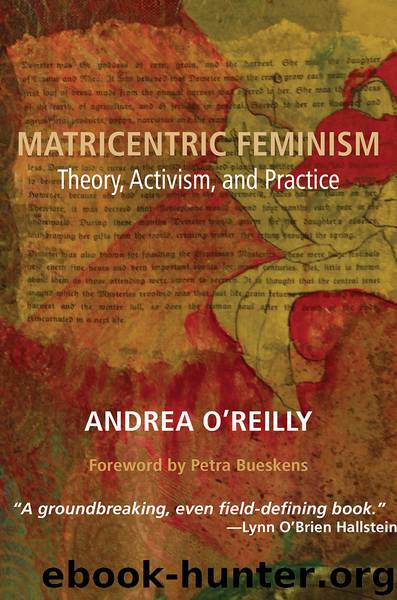
Author:Andrea O’Reilly
Language: eng
Format: epub
Publisher: Demeter Press
Published: 2016-04-12T04:00:00+00:00
3.
MATRICENTRIC FEMINISM AS PRACTICE
Feminist Mothering
THIS CHAPTER, developed from my published works on feminist mothering as well as from my recent reflections on the subject matter, is to be read as an overview of the central issues, questions, and concerns of feminist mothering as practice. In so doing, it looks at feminist mothering from the perspective of both children and mothers. The chapter is divided into five sections. The first section looks at the problematic of defining feminist mothering and develops a possible theory of feminist mothering. The following two sections examine the meaning and practice of feminist mothering for daughters and sons. As these sections explore the rewards of feminist mothering for children, the fourth section, considers its risks. The final section calls for a mother-centred mode of feminist mothering that regards the empowerment of mothers as its primary focus and aim.
FEMINIST MOTHERING: FROM THE PROBLEMATIC OF DEFINITIONS TO THE POSSIBILITY OF PRACTICE
Mothering and Motherhood
Central to Of Woman Born, as discussed in the opening chapter, is the distinction Rich makes between patriarchal motherhood and the possibility or potentiality of feminist mothering. Although much has been published on patriarchal motherhood since Rich’s inaugural text—research that documents why and how patriarchal motherhood is harmful, indeed unnatural, to mothers and children alike—little has been written on the possibility or potentiality of feminist mothering. “Still largely missing from the increasing dialogue and publication around motherhood,” as Fiona Green writes, “is a discussion of Rich’s monumental contention that even when restrained by patriarchy, motherhood can be a site of empowerment and political activism” (“Feminist Mothers” 31).
The introduction to my edited volume Feminist Mothering opens with a review of publications on motherhood in the mainstream media. These books would suggest that the selfless and doting mother of yesteryear has, like the eighteen hour bra, fallen out of fashion. These authors, particularly those that write in the self-help genre, call for a new style of mothering, one that advocates balance and admonishes guilt. Bria Simpson, for example, asserts in The Balanced Mom: Raising Your Kids without Losing Your Self that “We need to continue, rather than deny, the development of ourselves to be fulfilled” (2). She goes on to write: “As you try so fervently to help your children develop into their best selves, I encourage you to refocus some of that energy into living your best life” (3). Likewise, Amy Tiemann, in her book Mojo Mom: Nurturing Your Self While Raising a Family, claims that “all women need to continue to grow as individuals, not just as Moms” (xvi). Overcoming the guilt of motherhood is the focus of many books, as with the bestselling book, appropriately titled Mommy Guilt: Learn to Worry Less, Focus on What Matters Most, and Raise Happier Kids (Bort et al.). Other writers challenge the excessive child centredness of contemporary parenting practices and call for a more “children should be seen and not heard” philosophy of childrearing. Christie Mellor in The Three-Martini Playdate: A Practical Guide to Happy Parenting for example, asserts:
You were here first.
Download
This site does not store any files on its server. We only index and link to content provided by other sites. Please contact the content providers to delete copyright contents if any and email us, we'll remove relevant links or contents immediately.
Doing It: Let's Talk About Sex... by Hannah Witton(9324)
Thirteen Reasons Why by Jay Asher(9007)
The Girl Without a Voice by Casey Watson(7927)
The Incest Diary by Anonymous(7761)
Should I Stay or Should I Go? by Ramani Durvasula(7725)
The Lost Art of Listening by Michael P. Nichols(7551)
The Leavers by Lisa Ko(6982)
The Testaments by Margaret Atwood(6980)
The Space Between by Michelle L. Teichman(6978)
The Four Agreements by Don Miguel Ruiz(6837)
Rich Dad Poor Dad by Robert T. Kiyosaki(6728)
The Rosie Project by Graeme Simsion(6528)
Beartown by Fredrik Backman(5846)
We Need to Talk by Celeste Headlee(5672)
Ego Is the Enemy by Ryan Holiday(5532)
Men In Love by Nancy Friday(5308)
Spare by Prince Harry The Duke of Sussex(5265)
Hunger by Roxane Gay(4978)
Suicide Notes by Michael Thomas Ford(4871)
